
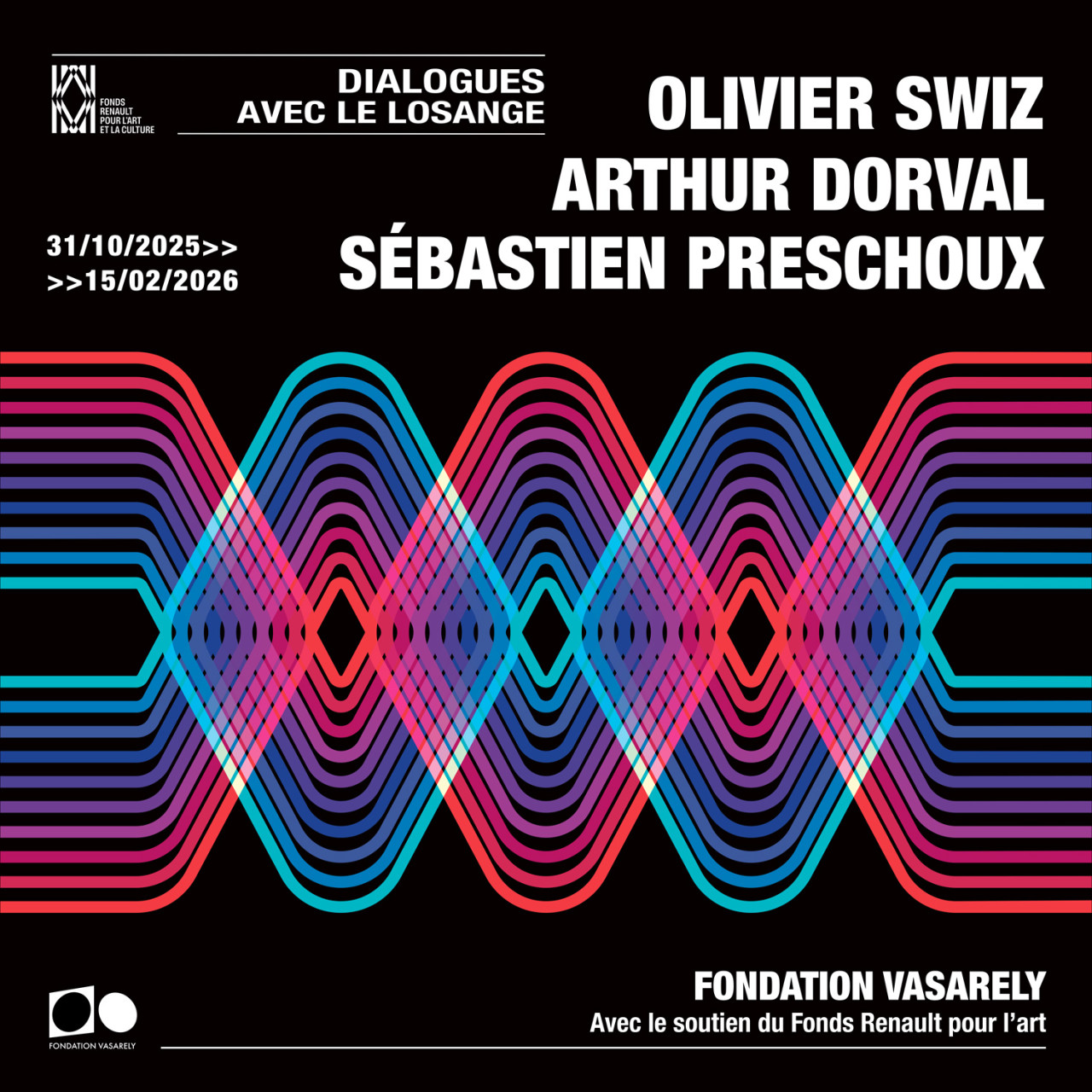
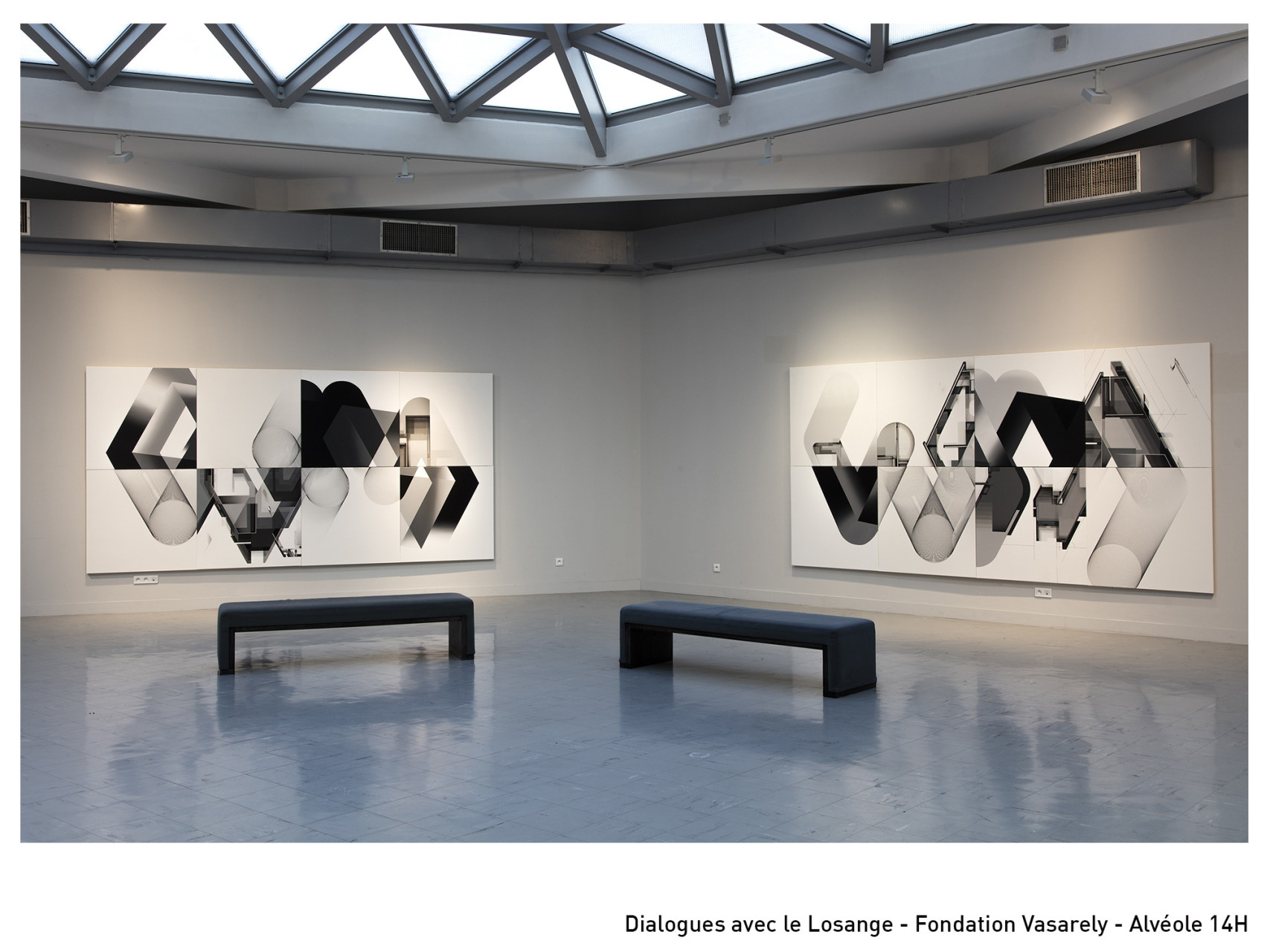
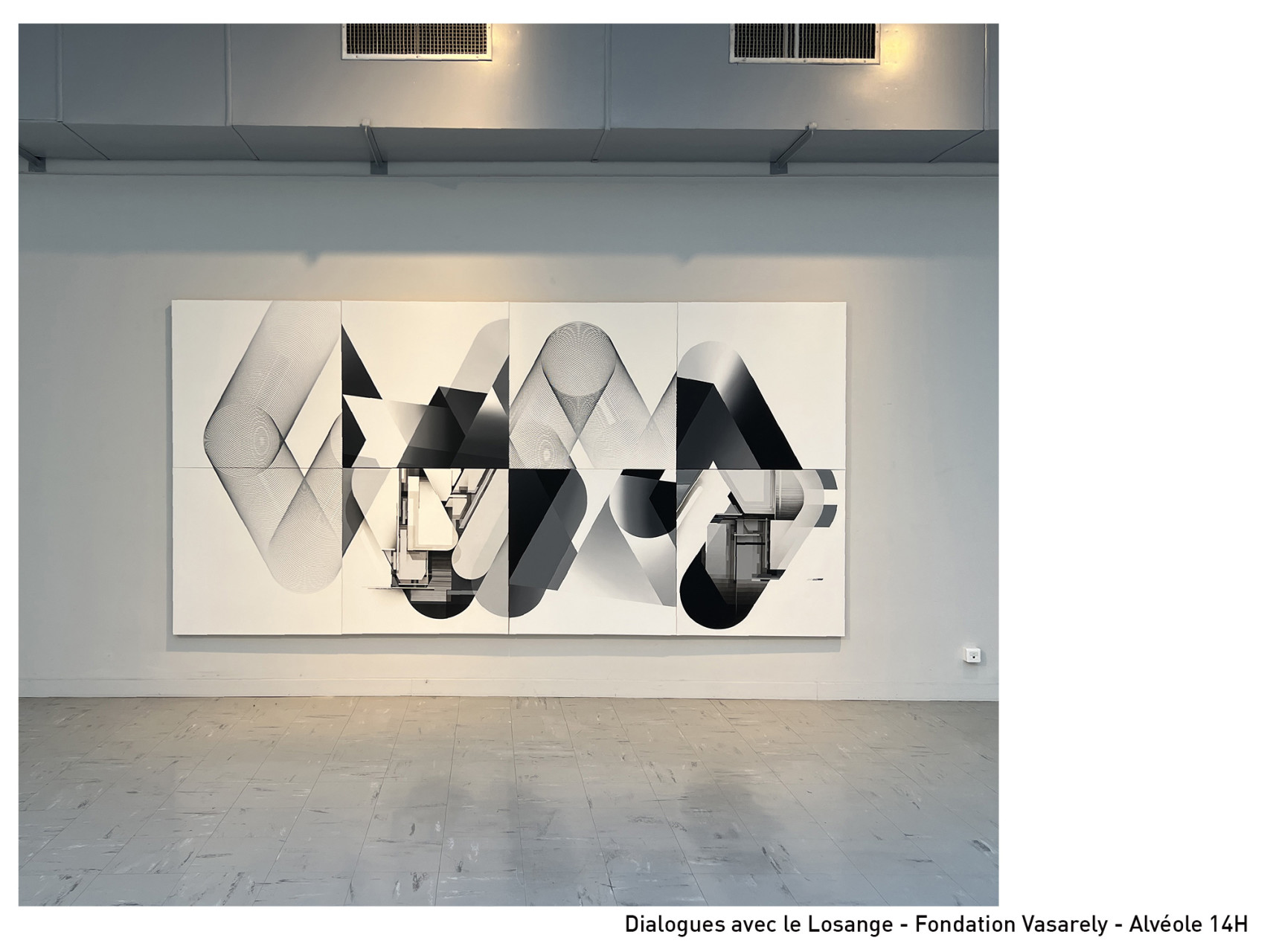
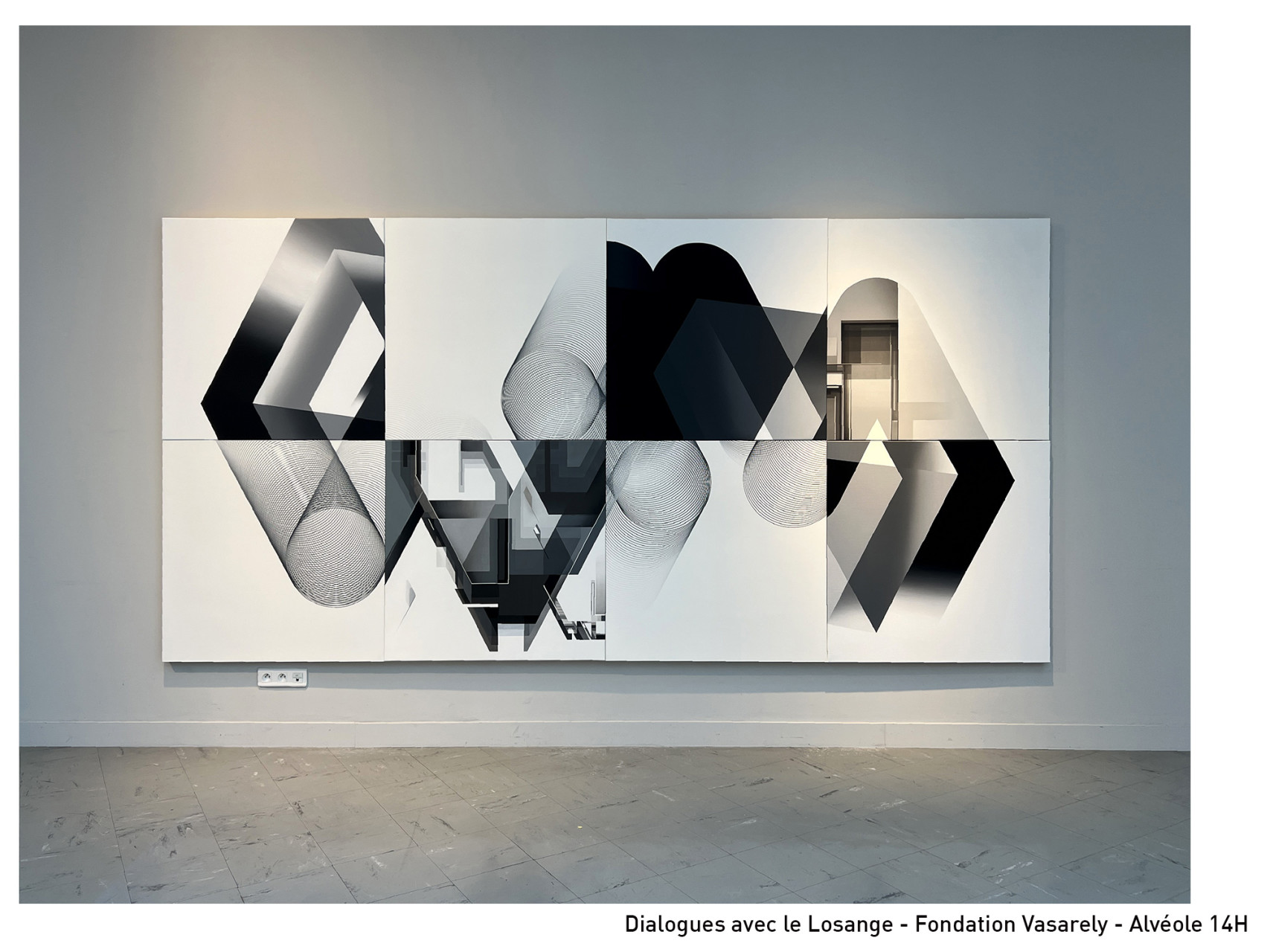
Outside the walls “Dialogues avec le Losange” – ARTHUR DORVAL x SÉBASTIEN PRESCHOUX x SWIZ – Fondation Vasarely – Aix en Provence – October 31, 2025 > May 3, 2026
To mark the 100th anniversary of the Renault diamond logo
In partnership with the Renault Fund for Art and Culture
Curated by Karim Boukercha
Produced by David Bloch Gallery
—
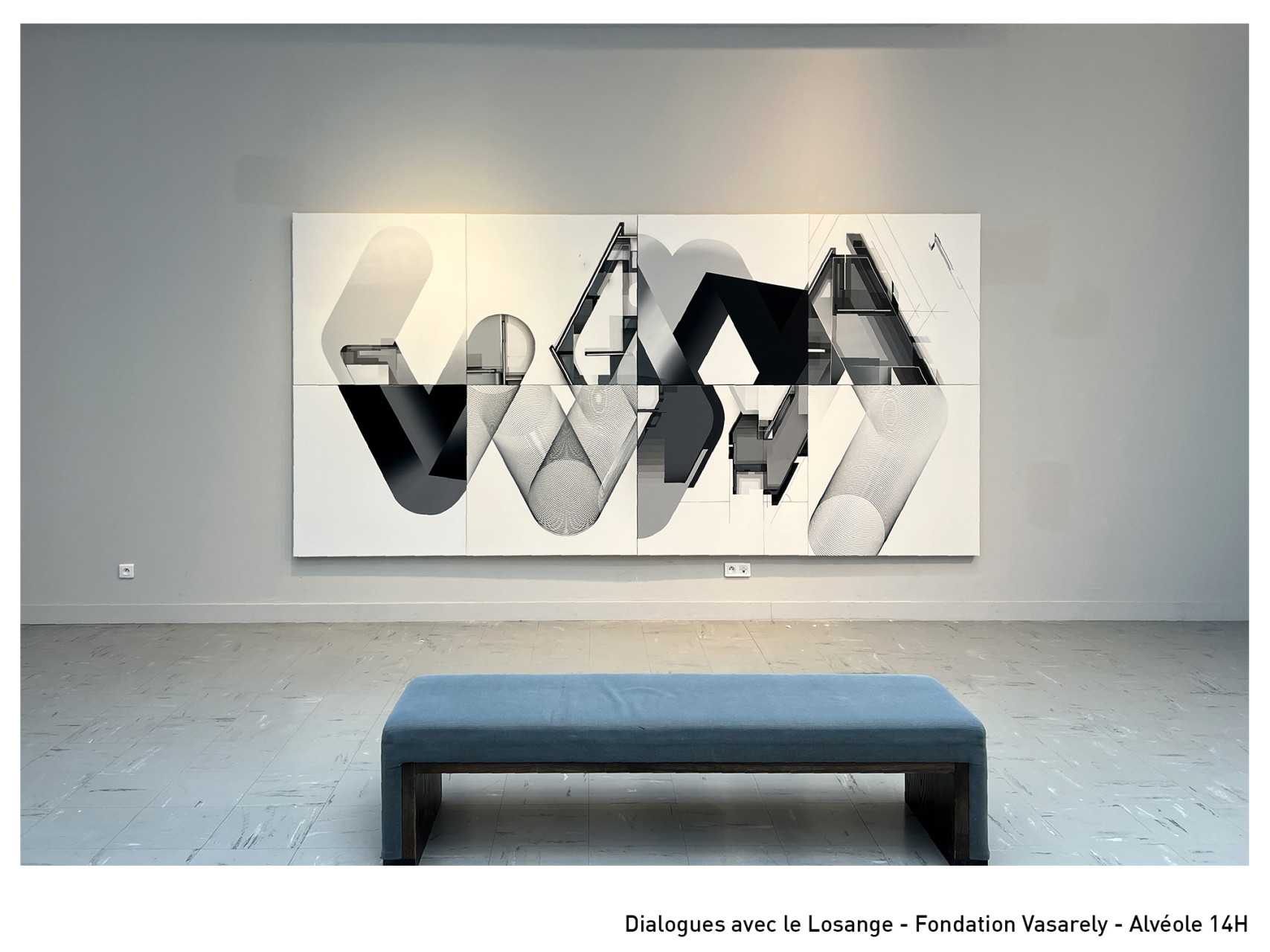
Arthur Dorval, Sébastien Preschoux, and Olivier Swiz have taken over three emblematic spaces of the Fondation; Vasarely’s historic office, reactivated as an immersive laboratory; Room 14H, transformed into a collective workshop; and the monumental galleries, where sculptures resonate with the architecture of the space. From the intimacy of the creative space to architectural monumentality, the exhibition unfolds in three stages, like a living dialogue with Vasarely’s legacy.
—
VASARELY’S OFFICE
“The polychrome city of happiness will be the city of tomorrow.”
— Victor Vasarely, Notes and Speeches on the Polychrome City of Happiness, Fondation Vasarely, Aix-en-Provence, 1976
(archives of the Foundation)
— Victor Vasarely, Notes and Speeches on the Polychrome City of Happiness, Fondation Vasarely, Aix-en-Provence, 1976
(archives of the Foundation)
In 1955, Victor Vasarely envisioned the dream of a “polychrome city of happiness” a world where art would no longer be confined to museums, but seamlessly integrated into architecture, present in everyday life, and accessible to all.
Seventy years later, urban art embodies this ideal of art living at the heart of the city.
The exhibition Dialogues with the Diamond brings together three contemporary artists Arthur Dorval,, Sébastien Preschoux, and Olivier Swiz , who, like Vasarely, explore geometric abstraction, optical art, and kinetic form.
Conceived to celebrate the centenary of the Renault diamond, the exhibition brings together these artists around this iconic form. In 1972, Vasarely, together with his son Yvaral, reimagined the brand’s emblem, transforming it into an optical and kinetic symbol. As a central figure in Vasarely’s “plastic alphabet,” the diamond now serves as a space for
intergenerational dialogue.
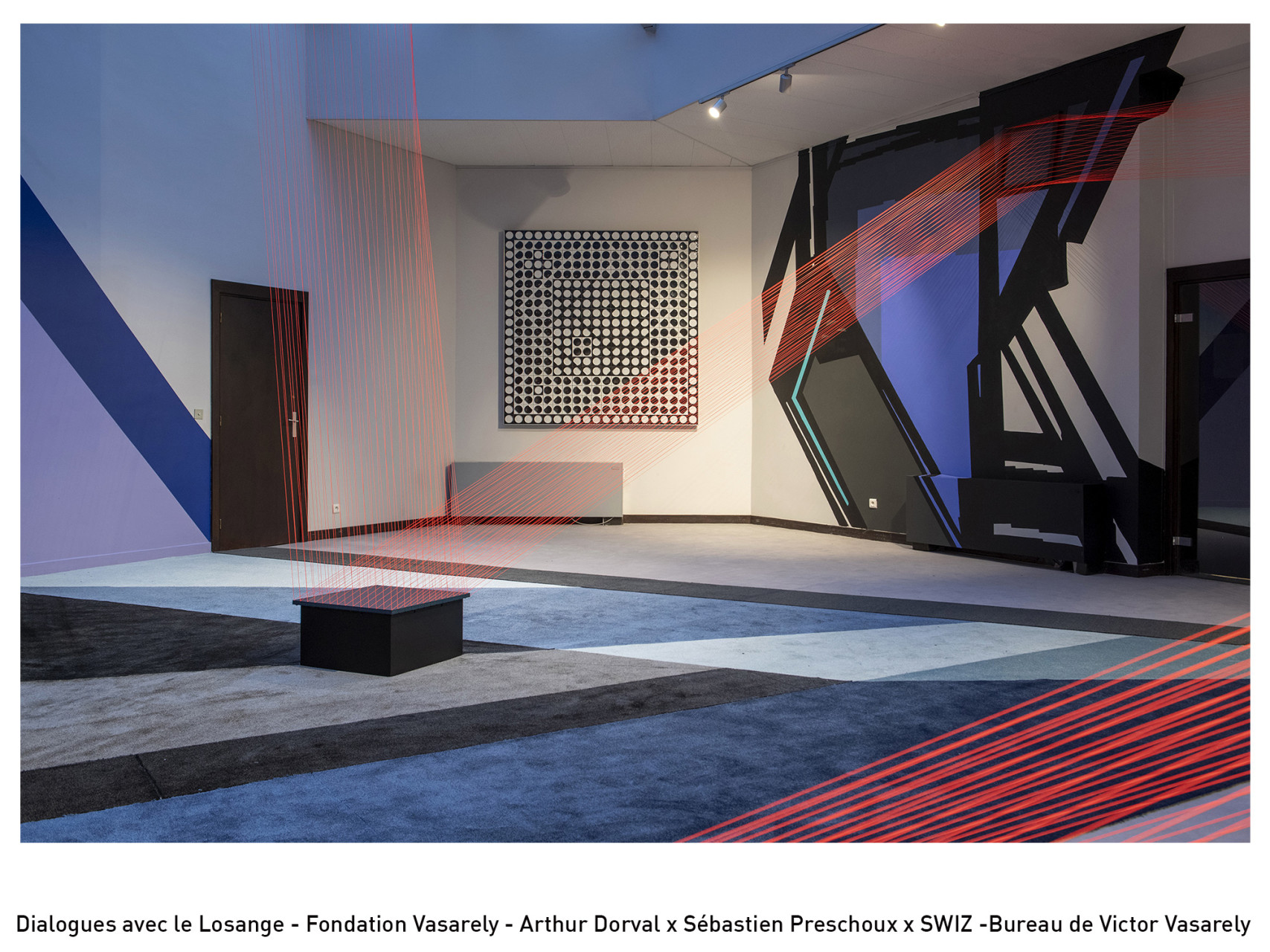
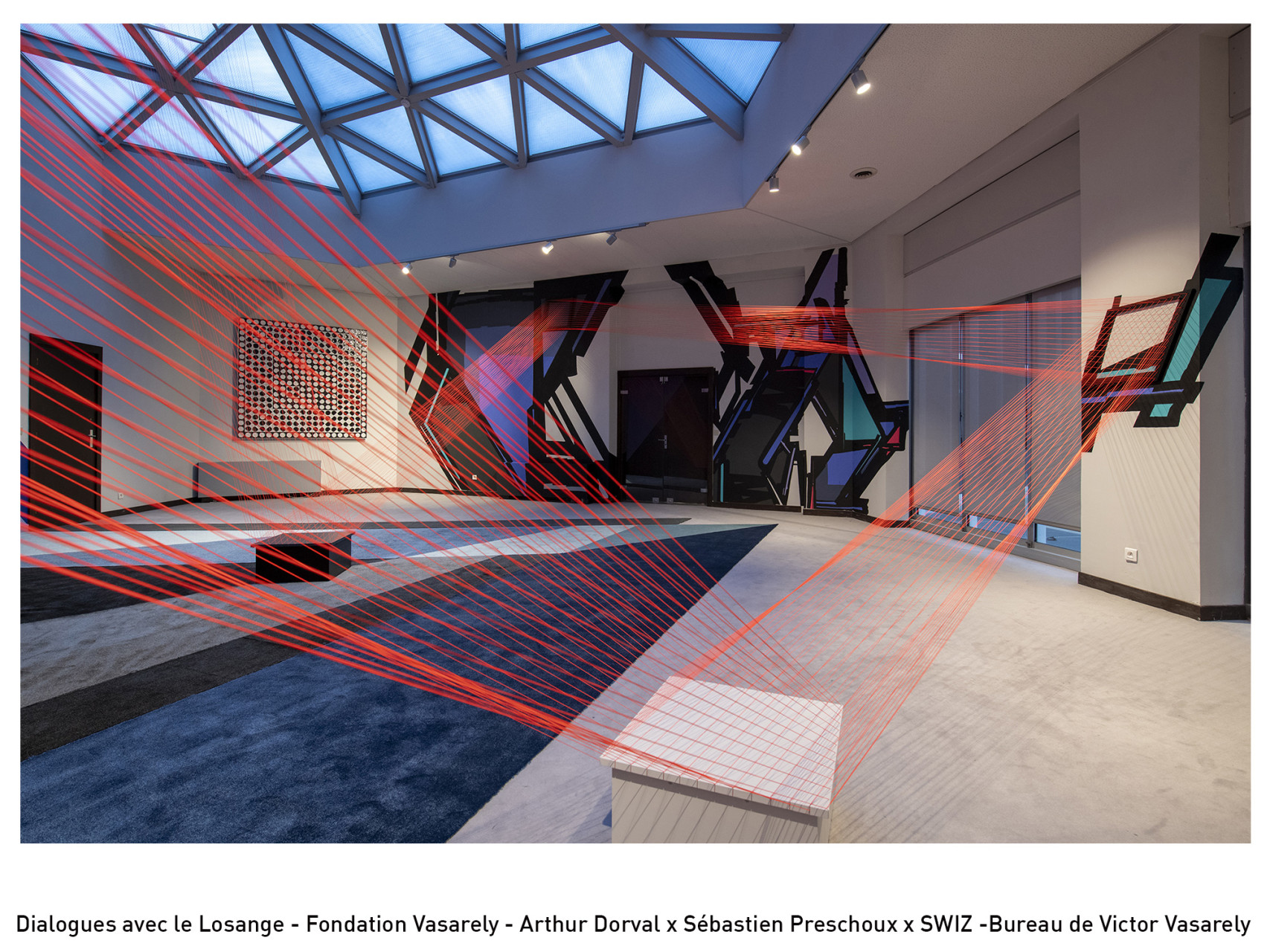
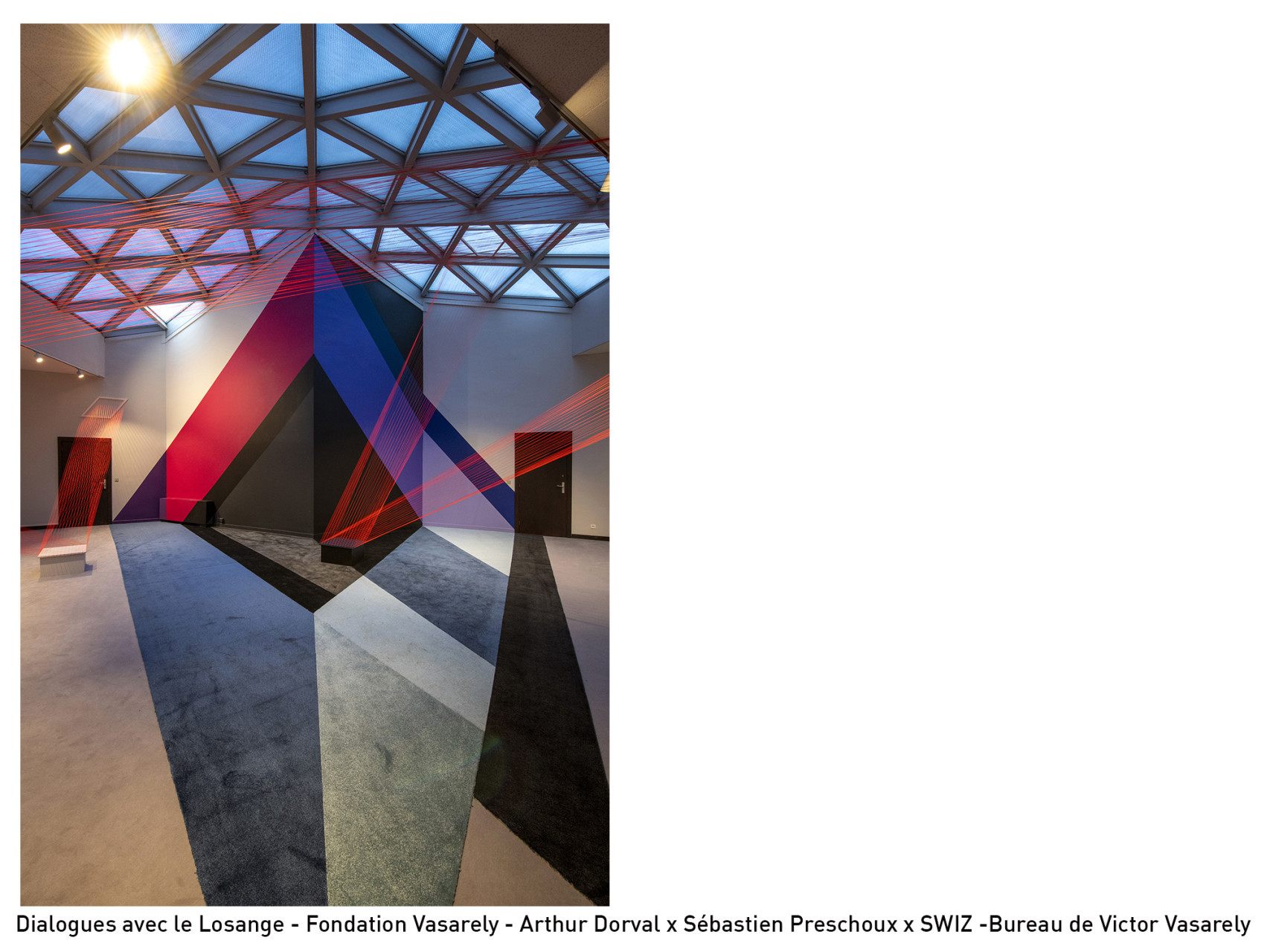
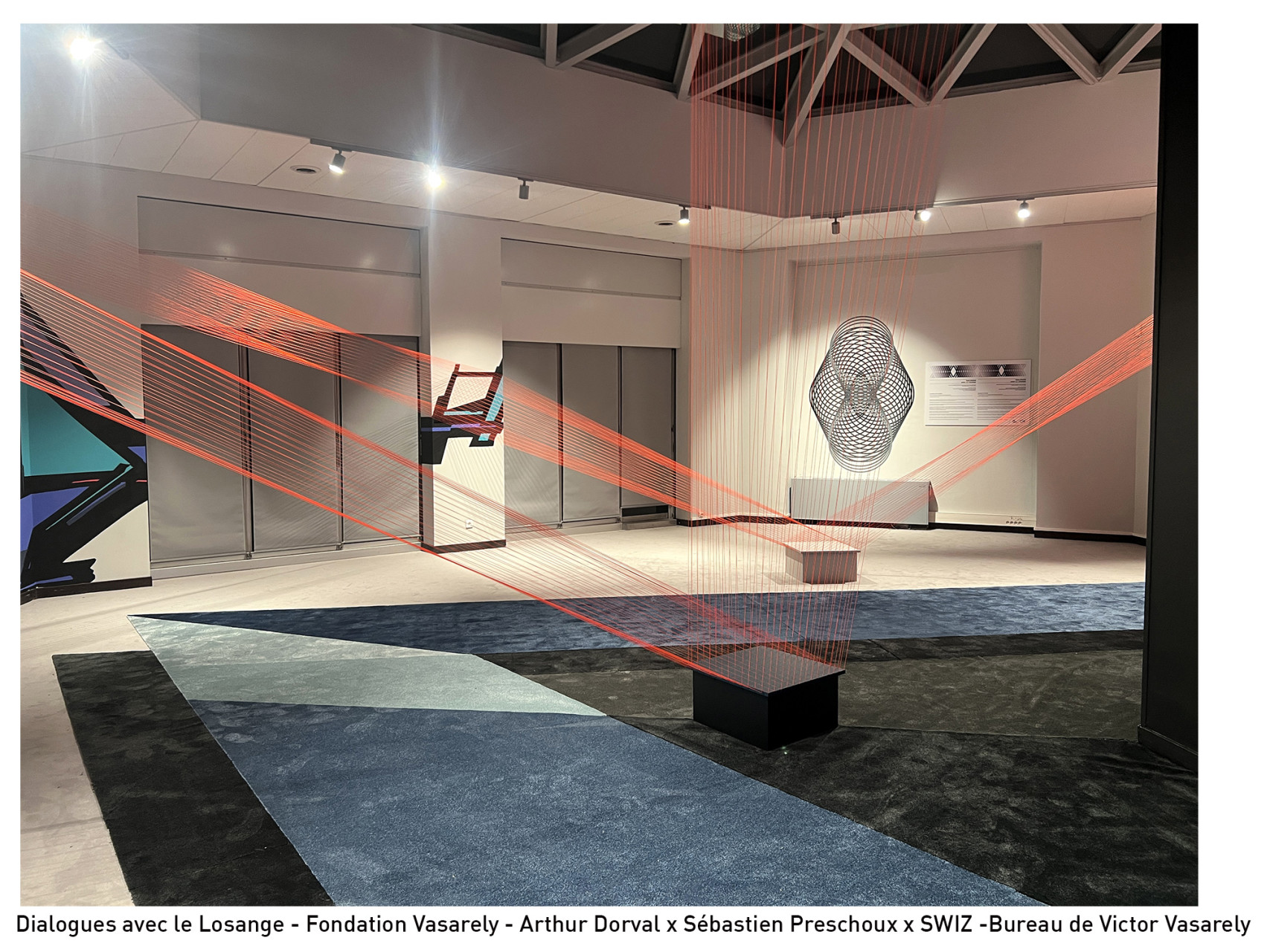
This encounter unfolds within Vasarely’s historic office — a space once closed to the public. It was here that the artist envisioned and developed major projects dedicated to the integration of art and architecture.
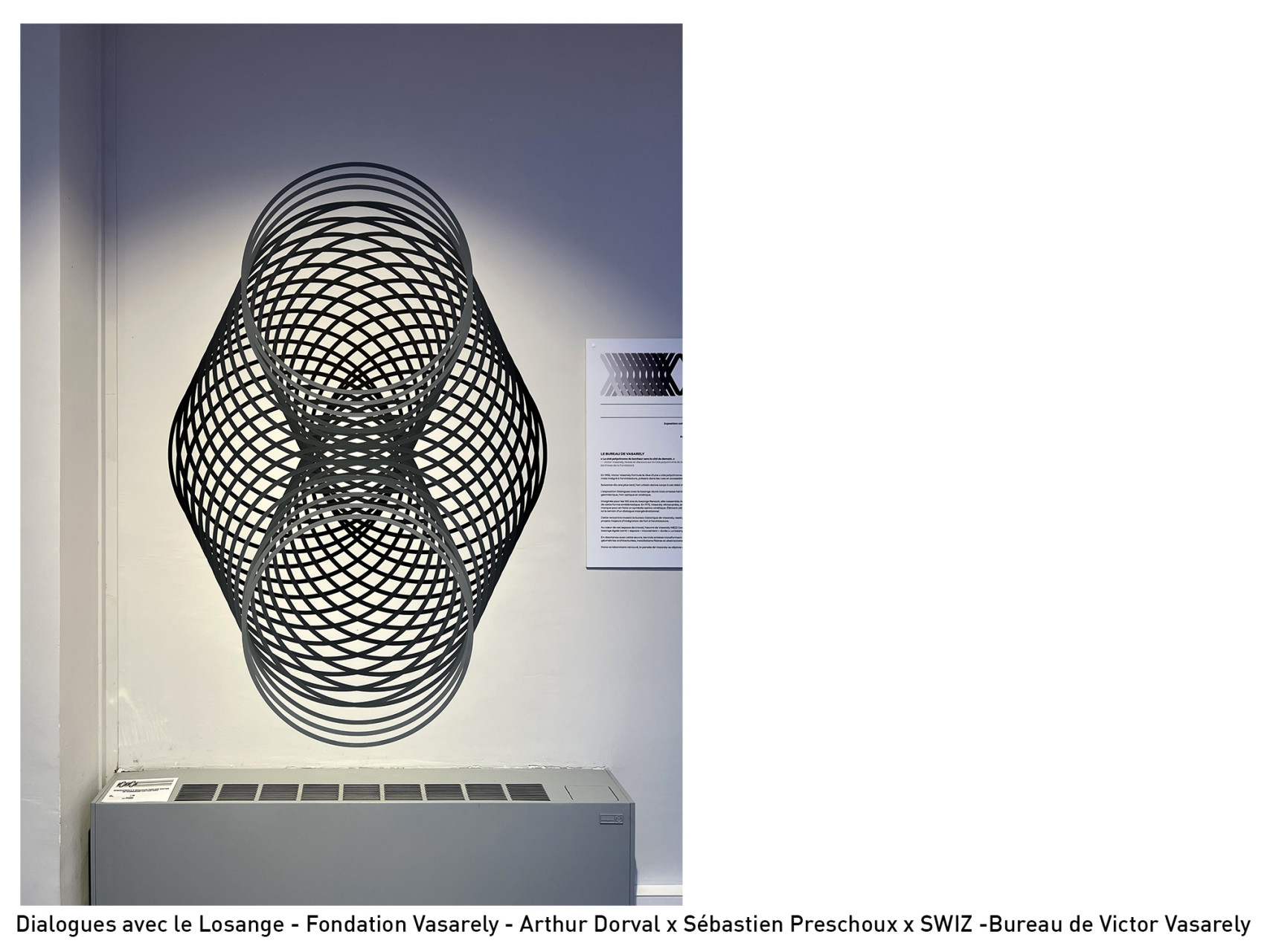
At the heart of this working space, Vasarely’s work NB22 Caope (1970) embodies the formula from his Yellow Manifesto : “the diamond equals square + space + movement + duration.” The diamond is a square in motion.
In resonance with this piece, the three artists transform the office into a kaleidoscopic journey, where architectonic geometries, thread installations, and chromatic abstractions compose a vibrant environment.
Seventy years later, urban art embodies this ideal of art living at the heart of the city.
The exhibition Dialogues with the Diamond brings together three contemporary artists Arthur Dorval,, Sébastien Preschoux, and Olivier Swiz , who, like Vasarely, explore geometric abstraction, optical art, and kinetic form.
Conceived to celebrate the centenary of the Renault diamond, the exhibition brings together these artists around this iconic form. In 1972, Vasarely, together with his son Yvaral, reimagined the brand’s emblem, transforming it into an optical and kinetic symbol. As a central figure in Vasarely’s “plastic alphabet,” the diamond now serves as a space for
intergenerational dialogue.
This encounter unfolds within Vasarely’s historic office — a space once closed to the public. It was here that the artist envisioned and developed major projects dedicated to the integration of art and architecture.
At the heart of this working space, Vasarely’s work NB22 Caope (1970) embodies the formula from his Yellow Manifesto : “the diamond equals square + space + movement + duration.” The diamond is a square in motion.
In resonance with this piece, the three artists transform the office into a kaleidoscopic journey, where architectonic geometries, thread installations, and chromatic abstractions compose a vibrant environment.
Within this rediscovered laboratory, Vasarely’s vision expands into the present.
—
THE ROOMS AND THE MIRROR-POOL – Spatial and Luminous Resonances
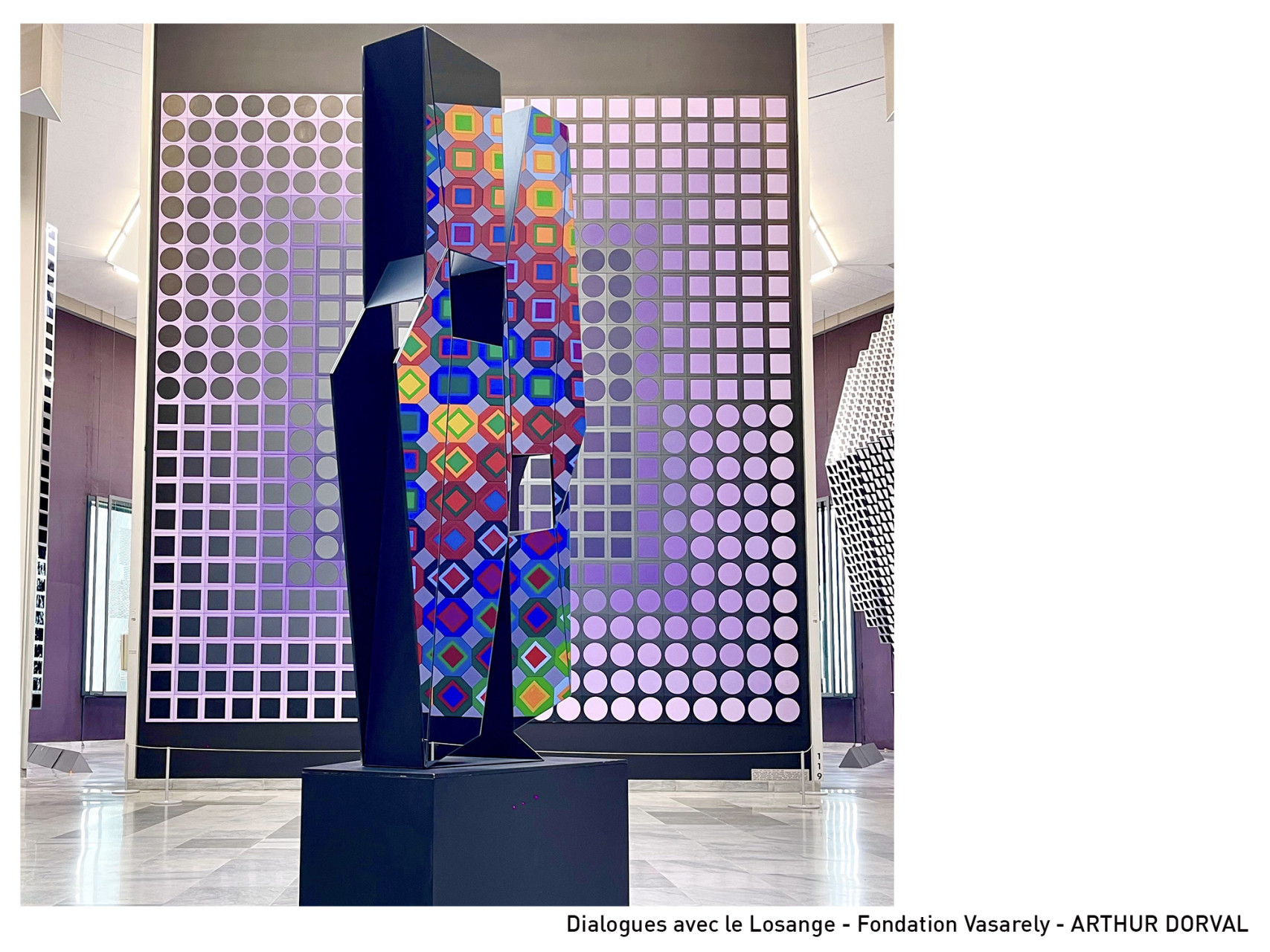
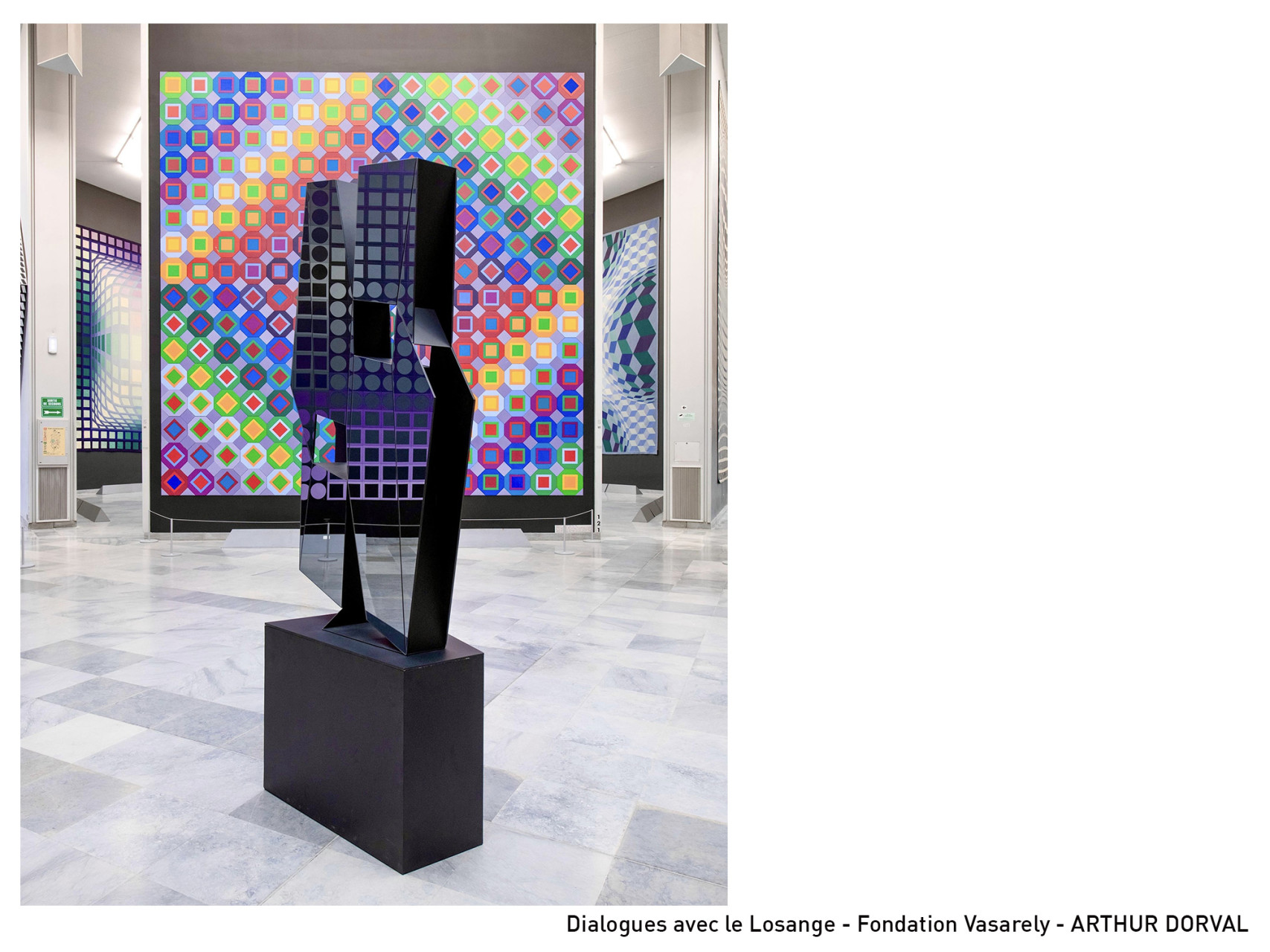
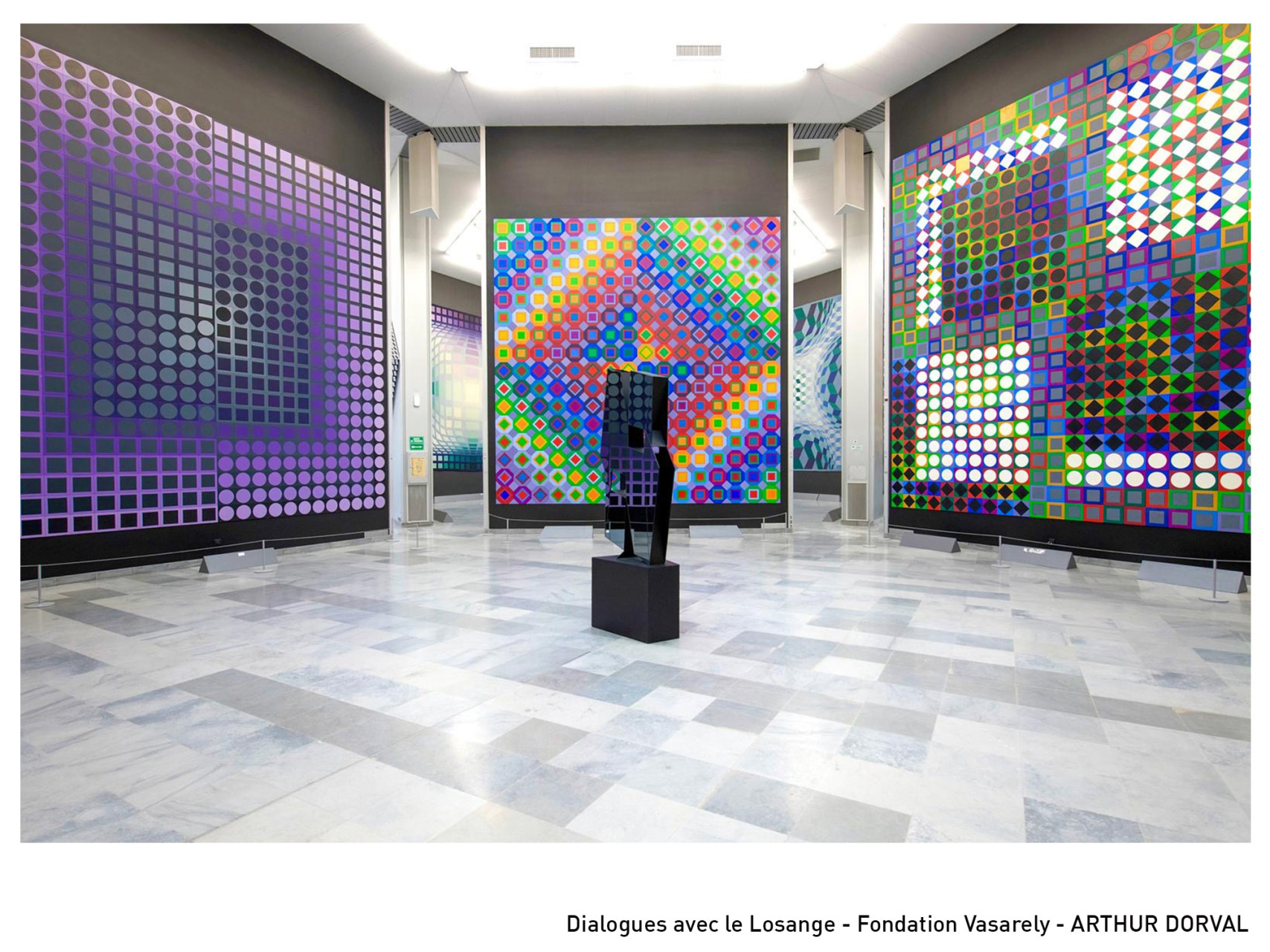
In the Foundation’s monumental hexagonal rooms, each artist presents a sculpture that resonates with Vasarely’s architectural integrations. By engaging their research with this universe, they extend the spatial, perceptual, and chromatic concerns that permeate geometric abstraction and demonstrate its enduring vitality.
In Room 5, Arthur Dorval transposes his Geometric Blossoms into a large, shimmering relief that multiplies the reflections of Vasarely’s monumental works. Through this mise en abyme, geometry becomes a luminous vibration, drawing the viewer into a shifting space where their own movement activates the artwork. The sculpture resonates with the reflective experiments conducted by Vasarely since the 1960s, transforming the mirror into a device for perceptual participation.
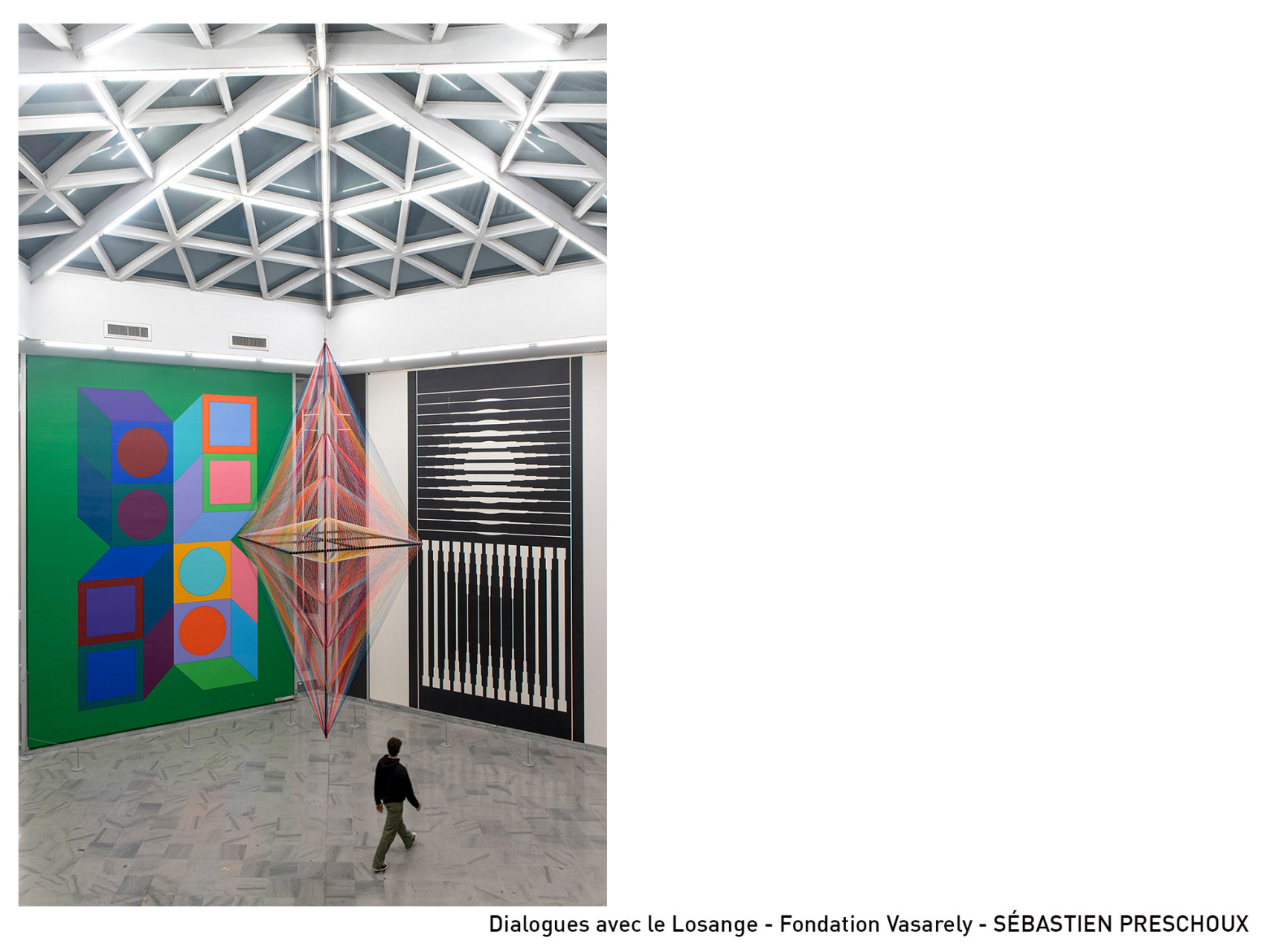
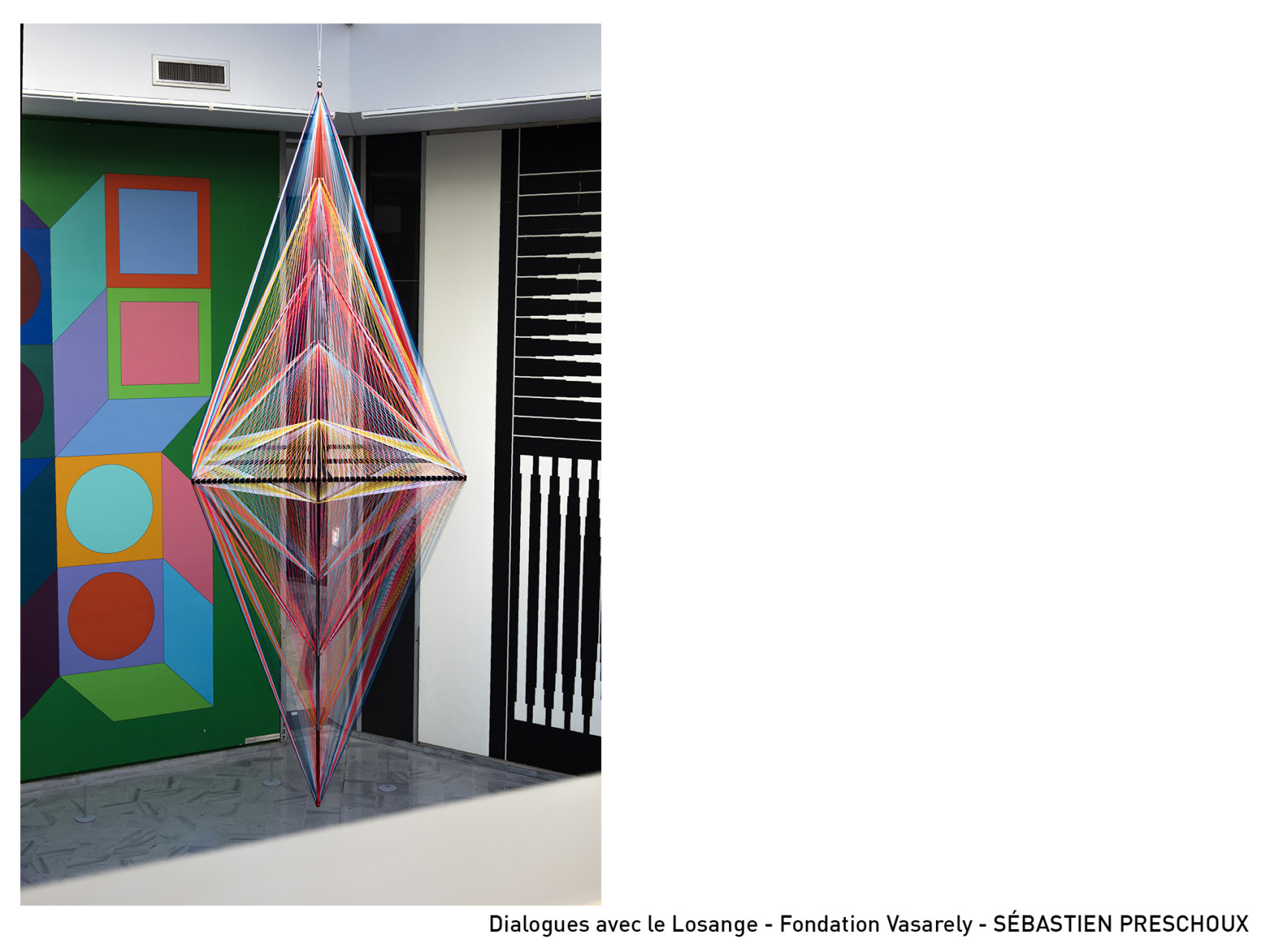
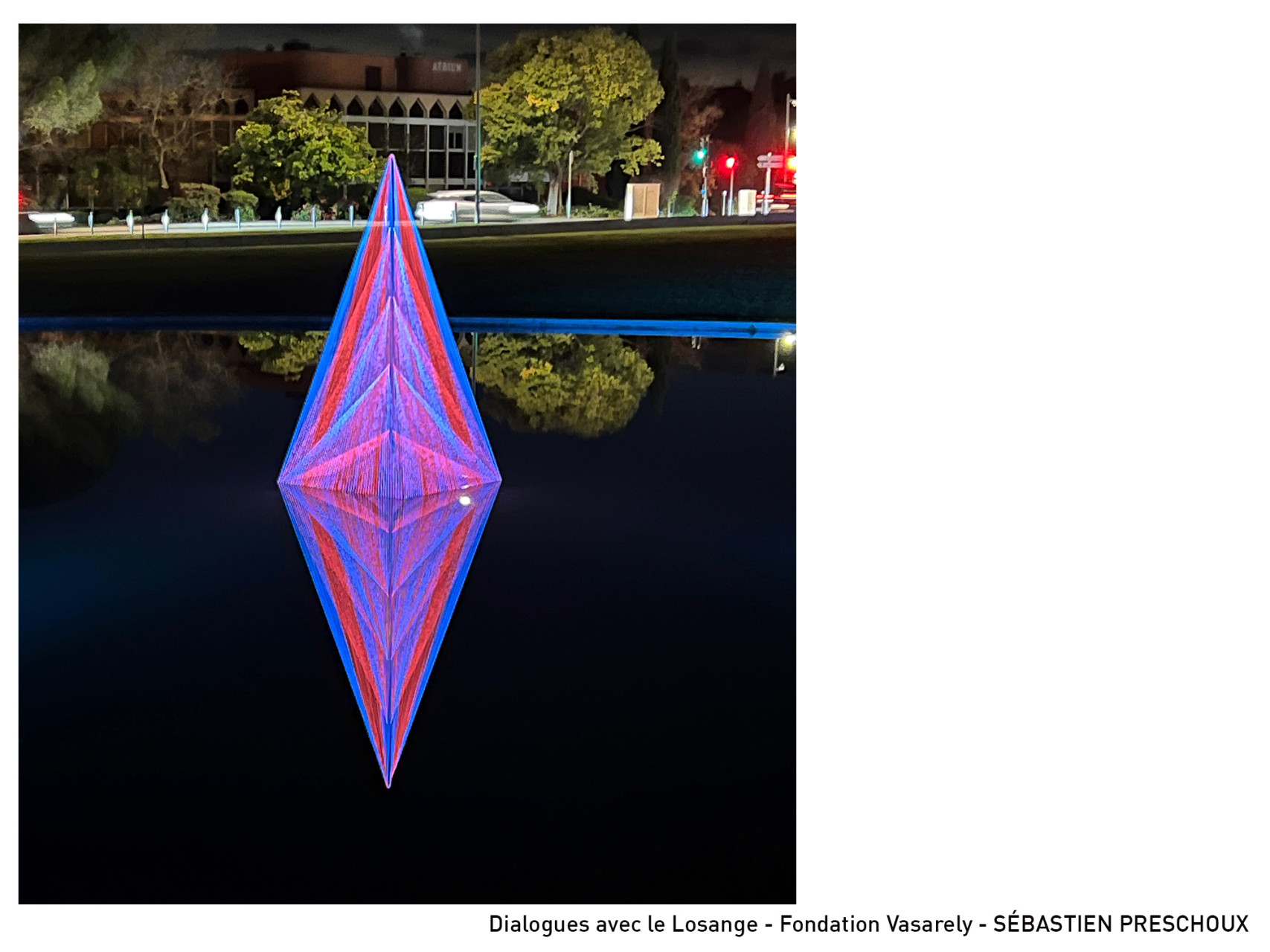
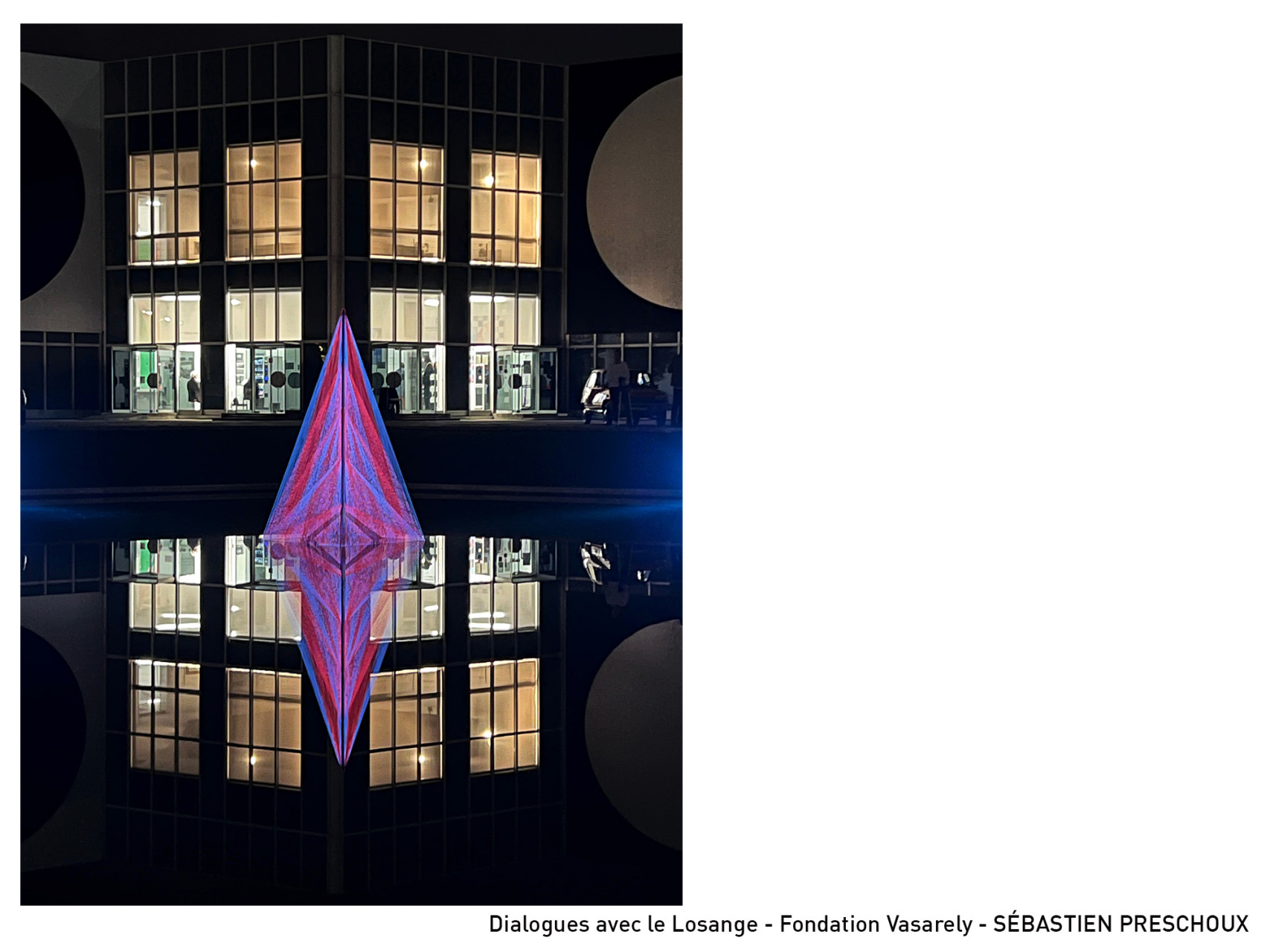
In Room 8, Sébastien Preschoux exhibits a wire mobile woven from taut lines and shifting shadows. In direct dialogue with Vasarely’s compositions, this aerial structure extends the rhombus into the third dimension. A second mobile is reflected in the mirror-like pool, where the water multiplies the form through moving reflections. Through this interplay of reflections, the work reveals Vasarely’s ambiguity between real form and reflected image, making perception an experience in perpetual transformation.
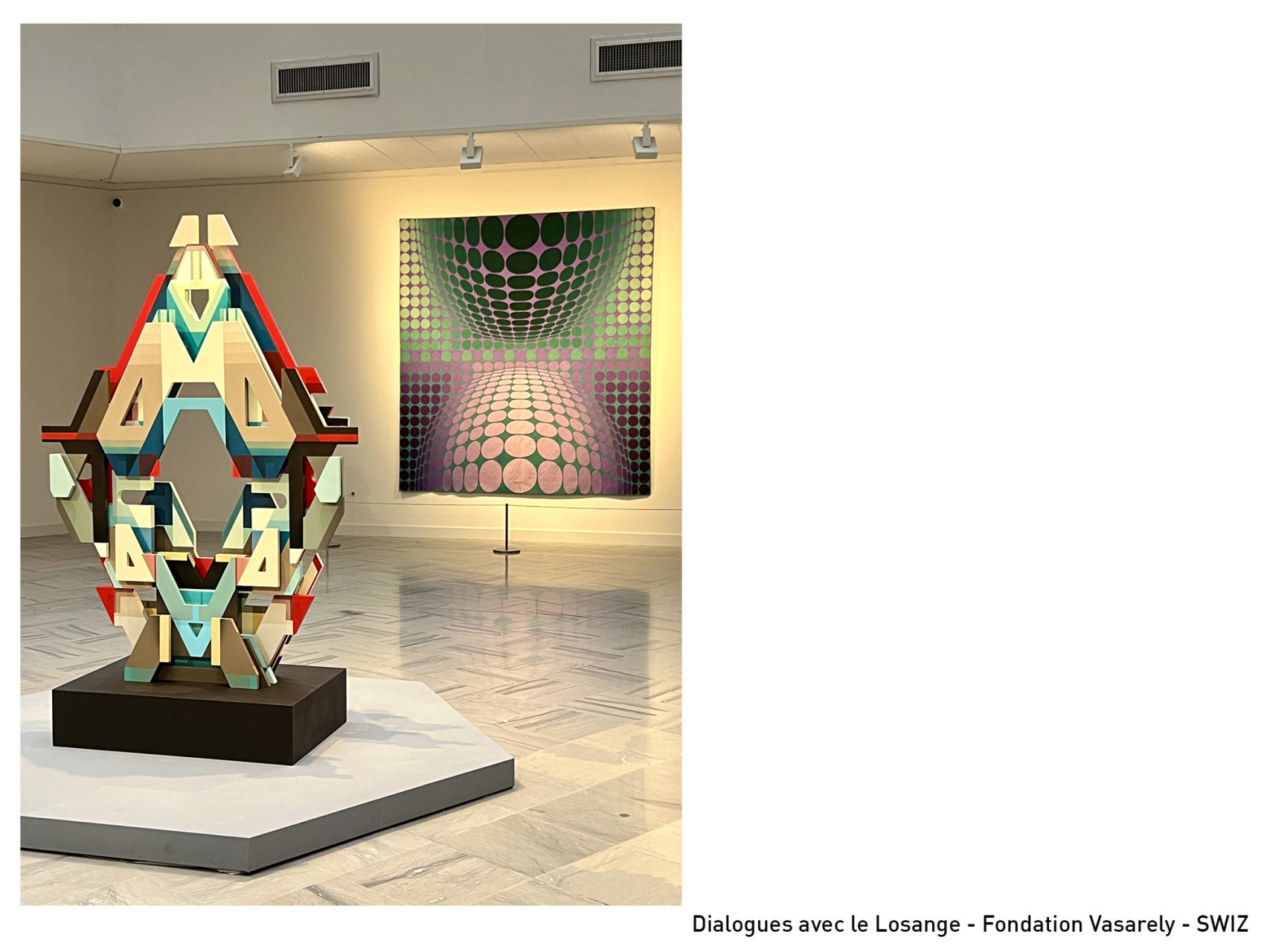
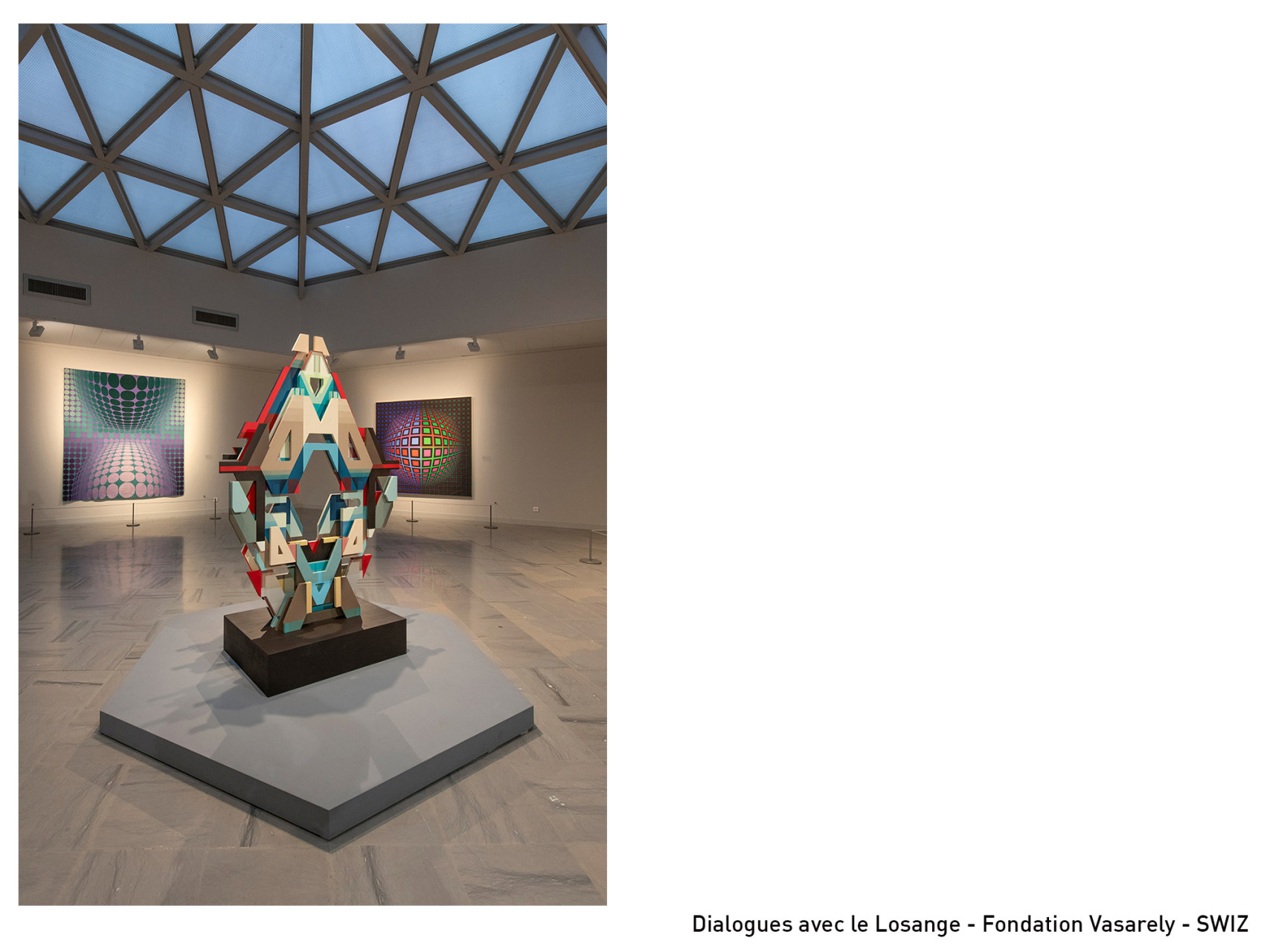
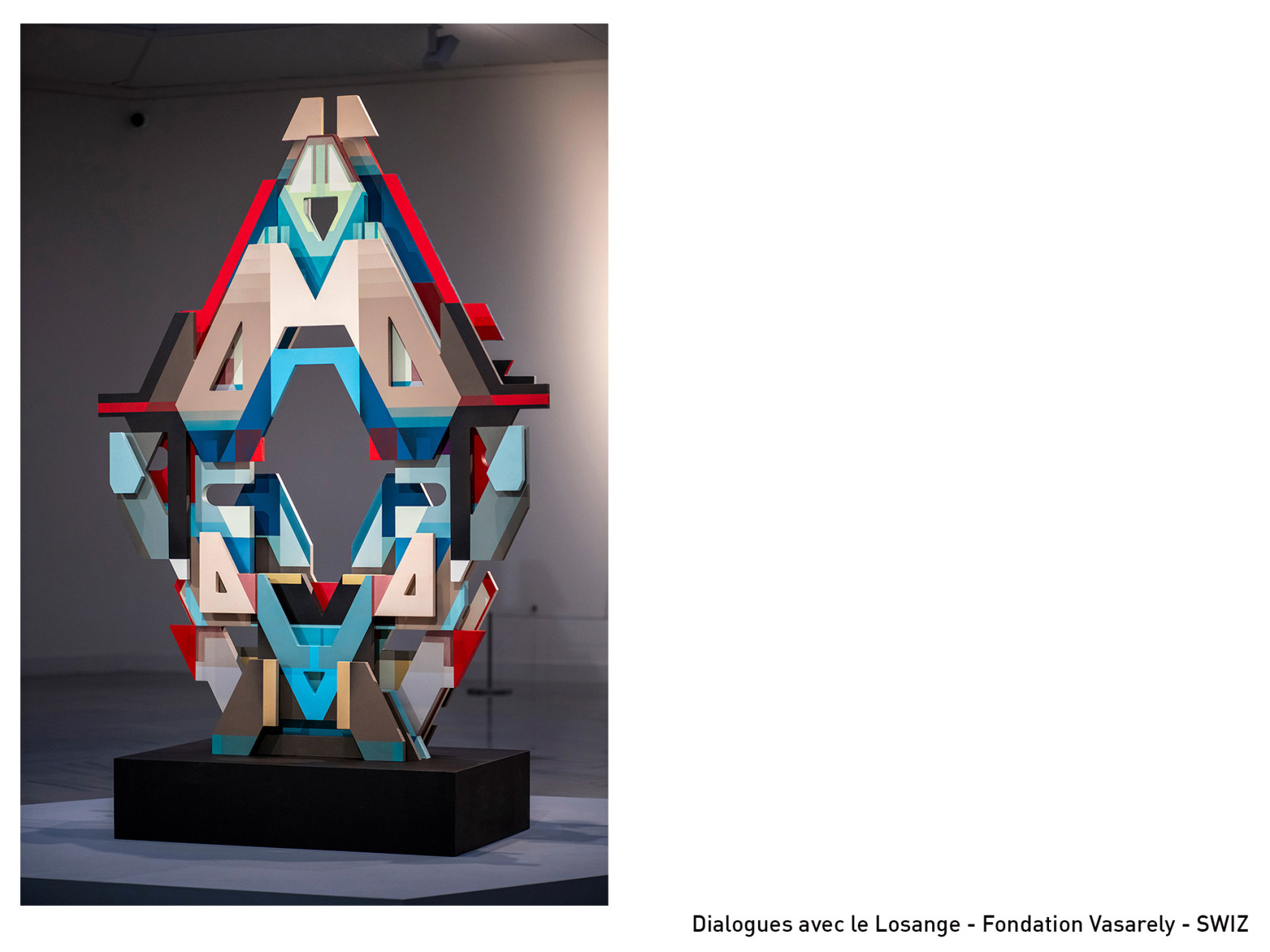
Finally, in the Lucien Arkas Room on the first floor, Olivier Swiz presents a sculpture conceived specifically for this space. This modular wooden construction adopts the principles of symmetry and superimposition of planes central to the Op Art movement. Open at its center, it frames Vasarely’s compositions in the background, which become integral parts of the artwork. The visitor’s movement multiplies the chromatic and spatial variations, the sculpture becoming a viewing device that updates Vasarely’s works.
—
THE ROOMS AND THE MIRROR-POOL – Spatial and Luminous Resonances
In the Foundation’s monumental hexagonal rooms, each artist presents a sculpture that resonates with Vasarely’s architectural integrations. By engaging their research with this universe, they extend the spatial, perceptual, and chromatic concerns that permeate geometric abstraction and demonstrate its enduring vitality.
In Room 5, Arthur Dorval transposes his Geometric Blossoms into a large, shimmering relief that multiplies the reflections of Vasarely’s monumental works. Through this mise en abyme, geometry becomes a luminous vibration, drawing the viewer into a shifting space where their own movement activates the artwork. The sculpture resonates with the reflective experiments conducted by Vasarely since the 1960s, transforming the mirror into a device for perceptual participation.
In Room 8, Sébastien Preschoux exhibits a wire mobile woven from taut lines and shifting shadows. In direct dialogue with Vasarely’s compositions, this aerial structure extends the rhombus into the third dimension. A second mobile is reflected in the mirror-like pool, where the water multiplies the form through moving reflections. Through this interplay of reflections, the work reveals Vasarely’s ambiguity between real form and reflected image, making perception an experience in perpetual transformation.
Finally, in the Lucien Arkas Room on the first floor, Olivier Swiz presents a sculpture conceived specifically for this space. This modular wooden construction adopts the principles of symmetry and superimposition of planes central to the Op Art movement. Open at its center, it frames Vasarely’s compositions in the background, which become integral parts of the artwork. The visitor’s movement multiplies the chromatic and spatial variations, the sculpture becoming a viewing device that updates Vasarely’s works.
—
Texts : Karim Boukercha
Photos : Hervé Hôte – Fabrice Lepeltier – David Bloch Gallery
Photos : Hervé Hôte – Fabrice Lepeltier – David Bloch Gallery